
Last time, I wrote about how Marvel's "weird mystery" anthology Tower of Shadows rode a wave of interest in the supernatural in comics publishing. That wave led to the popularity of spooky Gothic romance comics, like Sinister House of Secret Love; a revival of the sci-fi monster stories by Kirby and Ditko; and ongoing series like Tomb of Dracula and Werewolf By Night.

Tower morphed into Creatures on the Loose and hosted a couple of science-fantasy/sword and sorcery features ( another huge trend in Seventies comics, with its roots in the fantasy revival among Sixties college-age readers.) But in issue 30, cover-dated July 1974, the sci-fi werewolf was awarded his own series, by Doug Moench and George Tuska, under a cover by Kane and Romita Sr.
Tuska became a favourite of mine, as I entered middle-age. He was the first Marvel artist to depict Tom Baker( in Golden Voyage of Sinbad) and the Planet of the Apes. He drew the earliest issues of the Champions, a C-List super-group which was among the very first (semi) regular US Marvels on sale when I started secondary school. To me, the late George Tuska is the definitive artist for Iron Man, Luke Cage, Power Man and Black Goliath; his style is quirky and dynamic, but his characters at Marvel inhabit a recognisable, urban world. As one of the artists who defined Marvel's house style, he legitimises the Man-Wolf series.

The premiere issue is short- there was a reprint about a boxer with a literal glass jaw- and it recaps the story so far of John Jameson, who is still a redhead, although he was brown-haired until the Morbius story.
John's dialogue claims, rather oddly, that Morbius has permanently affixed the Moonstone and yet what we actually saw him do was bite Jameson to give him mental control, as Dracula might.
The story also introduces an antagonist, ex-CIA agent and Special Police Force Operative, Simon Stroud. He's a rather bland, macho type whose speech-patterns ( "this shambles-scene") are pure Moench, If you hadn't realised a classic movie buff was scripting, maybe the climax on the Statue of Liberty gave it away, if you'd seen Hitchcock's Saboteur.
It's hard to see, so far, what we might get from this strip that we wouldn't experience in Werewolf By Night, aside from third-person narration and established ties to Spider-Man. As the author of WBN, Moench seems forced to rework familiar "wolf man" tropes, as he did briefly with Iron Fist after Shang-Chi.
I wanted to mention here, having omitted it twice already, that DC fans had already read a very fine werewolf story in the April 1974 Batman 255, a 100 page Super Spectacular. Len Wein and Neil Adams introduced Anthony Lupus, a former athlete transformed by the Mad Science of Professor Milo. This moody piece of rare Gothic Bat-horror was adapted for animation in 1992, where Lupus was renamed Romulus ( slightly less on-the-nose).
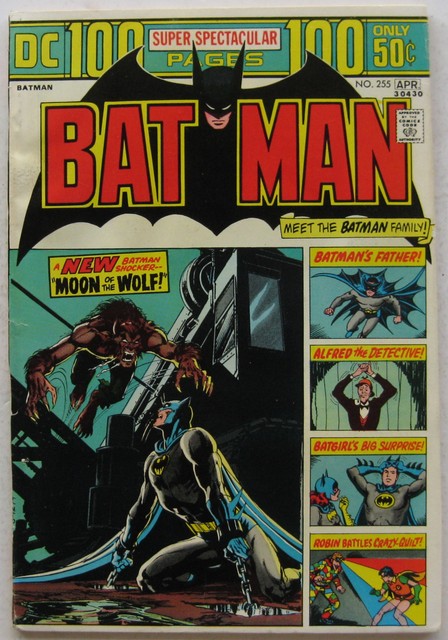
Lupus/Romulus is a glamorous, adult figure, like astronaut Jameson ("around 28": quite young for a 70s astronaut) while WBN's Jack Russell was a teenage, Californian drifter. The loss of control, status and lifestyle seems therefore both more ironic and dramatic for Lupus and Jameson (although the former is a Bat-antagonist, not a protagonist). Nonetheless, despite the unappealing art of Don Perlin and some weak stories, the complex and murky relationships with sister Lissa and writer Buck Cowan often make me think Werewolf By Night would make an effective and popular Marvel tv series.

CotL 31 features probably my favourite cover for this series and begins with Jameson washed downriver to Hudson Bay. In a recap, we discover Kristine does in fact have amnesia about John's lycanthropy. Jameson returns to JJJ again while NASA declare him AWOL and send the FBI to bring him in, PDQ.
Jameson's hair has changed from red to grey ( or lilac) but despite his fears that the Man-Wolf is a manifestation of his own hatred- and that could include Kristine- he visits her in person to break up with her. He is then arrested by police officers, who metatextually comment on themselves as "bit-players" in a horror film, just before Jameson changes to wolfman-form. He subsequently fulfills Jameson's prediction by hunting down Kristine.
Moench is replaced in the next issue by Tony Isabella, creator of the aformentioned Champions, Black Goliath and tv's Black Lightning. Isabella's 70s stories were steeped in 60s continuity, so now we have a sense of M-W being more tightly entwined with the Marvel Universe than Jack Russell.

As a former romance artist, Tuska draws a lovely Kristine, even when she's stalked by MW. Her rescuer is, as the cover might suggest, Kraven the Hunter. Isabella uses narration to emphasise Kraven's sense of nobility. He's Marvel's Paul Kirk,Manhunter more than Zaroff the cossack,
Fleeing cops and hunter, Jameson reverts and contacts Ralph "Rocks" Sarson, NASA researcher about the grafting of the moonstone. "Rocks" tips him off about the FBI.
Isabella depicts JJJ's mounting dread that Spider-Man might be the only person to whom he can turn for help with John. Jameson Jr. (now sporting brown hair again) is captured by Kraven and deposited in a "chamber" that screens out lunar radiation.
A little like John Byrne, Isabella is a passionate creator who has had a tempestuous relationship with the Big Two. At present he's extremely upset about the writing of Black Lightning's character in the modern Outsiders series. In his sole Man-Wolf story, however, he keyed right into the soap opera of 60s Spider-Man, with more of a 70s note of violence, with the reference to cops, seriously injured by Man-Wolf.

These comics are by no means a sample of the best of that era. The covers are smothered with copy; colouring is inconsistent; and the stories are retreads of more exciting and affecting issues of the Hulk, to name just one example. I suppose what makes them interesting to me is how rare and exotic even the most pedestrian Marvel title was, in the Energy Crisis Era. With the Marvel weeklies poised to expand the following year, the only US comics that found their way to me in the spring of '74 were stray copies of a Wein/Sal Buscema Defenders and a Tuska Iron Man. I don't recall Foom Magazine 5 even being offered to UK subscribers.
As was the way with many lower-tier Marvel features, the creative team of Man-Wolf was about to change yet again, with the debut of an artist who'd become one of the most popular and successful of the Eighties.
I'll look at the George Perez era of Man-Wolf in the next post. As the final scripter of Man-Wolf was wont to say: take care and stay aware.
All images are presumed copyright of their respective owners

No comments:
Post a Comment