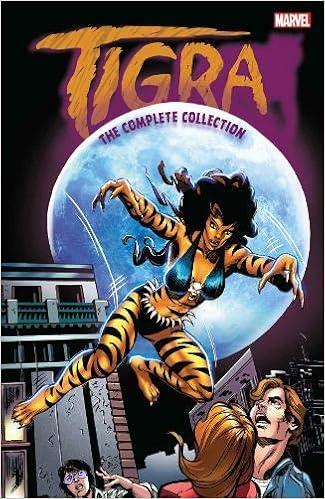
Tigra is both a Marvel monster-hero in the vein of the Hulk and the Thing, a product of the horror boom of the early 70s and an objectified, cheesecake character with a checkered past- one whose career is a sobering symbol of the treatment of women in comics.
Her origin begins in 1972 when Marvel was trying to woo a female readership with a raft of new titles, helmed by female creators.
The statuesque Kirby Kreation, regal Medusa had featured in two late Sixties tryouts and another reformed villainess, the Black Widow had starred in her own brief solo series, revamped ( like Wonder Woman) in the mould of catsuited adventurer Emma Peel.
Perhaps these characters just weren't strong identification figures- the former, a scion of an insular, alien society founded on eugenics, the latter an ex-Russian spy and "honey trap", prone to weeping about a self-fulfilling "curse" on the men in her orbit.

By 1972, Black Widow was a romantic interest and crime fighting partner for Daredevil and Medusa was Sue's stand-in with the Fantastic Four. Three new heroines were launched, instead. Night Nurse, a soap/Gothic romance title; Shanna the She-Devil; and The Claws of the Cat. Nurses and life-or-death drama were a staple of romance novels and tv soap and Shanna was clearly Golden Age bombshell Sheena, Queen of the Jungle with SHIELD trappings (Sheena herself a pulp descendant of Rima, the Bird Girl from the novel Green Mansions and a 70s curiosity at DC in her own right.)

The Cat, similarly, seemed a bit of a derivative character from the self-styled House of Ideas. Julie Newmar ( and my personal favourite, Lee Merriwether) had immortalised Catwoman on tv ( and film) and although she hadn't appeared in a Batman comic since about 1969- an amazing absence, I think, to us today- the Feline Felon made a coincidental comeback in a 1972 Wonder Woman story by the late Denny O'Neil. It's a little like DC launching a Shazam series now, where Captain Marvel is a beery Aussie larrikin with a bad case of sibling rivalry and daddy issues.

Personally speaking, I didn't read the origin of the Cat until September 1975, when her strip was unearthed as a short-lived feature in the UK Super-Heroes Weekly. She was cover featured in green and blue rather than the vibrant yellow and blue (latterly Wolverine's colours.)
The heavyweight art team of Marie Severin and Wally Wood and the writer was Linda Fite, whom I only knew for a charming Jean Grey/Marvel Girl short in a 60s issue of X-Men. However, Marvel was earnestly trying to have visible female representation on the title.
The heroine is the Marvellously-alliterative Greer Grant Nelson, in a nod to Germaine Greer. She's a young widow whose consciousness is raised after the death of her controlling cop husband. Greer's mentor, Dr. Joanne Tumolo is working on a female-based super-soldier-type project in Chicago- a welcome departure from Marvel's Manhattan milieu but maybe subconsciously too like Catwoman's territory in Gotham City?
The Amazon woman project is funded by misogynist weirdo Mal Donalbain ( a Macbeth reference) and with the accidental death of the original subject, Greer gains the uniform with claw/grappling hook, night vision and intuitive or empathic abilities, which sometimes border on telepathy ( when necessary).
Donalbain commits suicide in his first clash with the newly-minted Cat and she makes short work of his zombie bodyguard. The semi-nude Zabo is such a Wally Wood character. I'm not a great fan of his Forties-style designs although I am quite fond of his fantasy stories for late-Sixties Marvel in Tower of Shadows.
The whole comic shimmers with a perversity that reminds me of Golden Age Wonder Woman but Greer's power set is too similar to Spider-Man and her environment is shadowy and glamorous in the style of Daredevil.
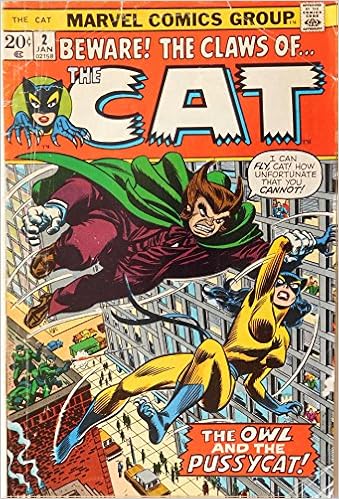
Similarities to DD continue in the second issue which features venerable villain, the Owl, to riff on Edward Lear. Maybe suborning the Owl from Daredevil would have helped the series in the long term, as drafting the Kingpin from Spider-Man did for the Man Without Fear in the early 80s. Joanne Tumolo literally loses her mind, after being injured in issue 1 and feels a lot like a proxy for Aunt May and Uncle Ben.
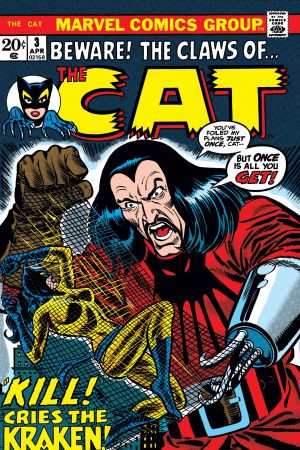
Drawn by Paty Greer ( later married to Dave Cockrum) and Bill Everett, issue 3 eschews the moody shadows of its predecessors for a light and airy fantasy, where a group of alien fox-men have a base at the bottom of Lake Michigan. Flamboyant and piratical Commander Kraken from Sub-Mariner is the special guest-villain. The next issue blurb promises The Witch - a suitable antagonist for a Cat.
But, instead, issue four continues to poach villains from other series- this tine Daredevil again, in the form of Man-Bull. This rather tedious minotaur is a riff on the Mr. Hyde character and he used to prey on swinging' hippie couples in DD stories. Here, he pervs on Greer and her friend Sally at the Union Stockyards. I liked the sense of a real locale and the Cat is lithe, acrobatic and sinuous. But the art by Alan Weiss and Jim Starlin is primitive and unappealing.I'm not able to find out if they make cameos on page two- I wondered if one of the passers-by is their pal, Steve Englehart?

The series ends here- a Ramona Fradon story,with a fussy tweaking of the Cat's costume, was never completed but it was to feature a "sinister sorceress". The Marvel Girl back-up was reprinted to fill out the issue and writer Fite married Herb Trimpe. Greer's story doesn't end here- apparently she did have a following and some fans wanted to see her as an Avenger.

Preliminary sketch cover of Claws of the Cat 5 by Gil Kane
She becomes more integrated with the wider MU in Marvel Team-Up 8, by Gerry Conway and Jim Mooney,cover-dated April 1973. Greer gets her own nemesis in the form of the Man-Killer, a crippled Olympic skier in an exo-skeleton, financed by AIM.
The very young Conway created a number of strident heroines ( Ms. Marvel I, Power Girl) and misandrist villainesses ( Killer Frost, Ten of Spades from the Royal Flush Gang). Greer brings down the Man-Killer by pointing out the hypocrisy of being the accomplice of the men of AIM. Ending the conflict through logic and rhetoric rather than through fisticuffs ( like Spidey) is quite a striking conclusion and suggests a cerebral heroine who would make a convincing Avengers chairperson.
Despite - or more likely because of-being a caricature feminist harridan, Man-Killer returned in 70s stories of DD and Iron Man but never in conflict with the Cat.
I feel that one of the reasons for the failure of Claws of the Cat was timing: if she had debuted a few years later, in the mid-70s, she might've had a longer run. But would Marv Wolfman's campy, vampy fan favourite, Black Cat have then been stifled?
The chopping and changing of art team didn't help either. Avengers membership in Englehart's era would've boosted her profile but he worked best with the characters he could direct himself. And I don't think Greer would ever have fought free from the shadow of Selina Kyle.
But loose ends did not go untied at Bronze Age Marvel. In the next post, we'll see how Greer was quite literally reborn in the pages of Giant-Size Creatures 1 in the summer of '74.
All images presumed copyright of their respective owners

No comments:
Post a Comment