However, that's out of my hands. What I can do is post a bit more often over the next five weeks.I want to pay tribute to the late Denny O'Neil and his work on Batman soon, but first, I'm continuing with my ongoing review of Marvel's Tigra: the Complete Collection.

Last time, I referred to creator Tony Isabella's announcement of new Tigra stories in Giant-Size Chillers, the comic which launched Lilith, Daughter of Dracula. (He also corrects pronunciation for readers- "Tie-gra",not Tee-gra). But the Mike Vosburg story about Jack the Ripper doesn't appear.
Something similar does though, in the second-last issue of the black-and-white Monsters Unleashed: a vehicle for shockers about Frankenstein's Monster ( and the first b/w Marvel monster mag I ever read).
"The Serenity Stealers" is moodily, scratchily drawn by Tony DeZuniga and plotted by Isabella, but the script is early Chris Claremont. The legendary X-Men writer had previously written some stories for Satana, the Devil's Daughter, a character I feel is an ancestress of Tigra: a lissome, conflicted horror-comic starlet.
This story is typical of the period: 70s macho men, "super-studs", are preyed upon by a rat-demon, who is in a symbiotic relationship with Surisha, an immortal succubus not unlike the 80s X-villain Selene. It reminds me of the Gabriel, Devil-Hunter series from Haunt of Horror.

I actually first read "The Serenity Stealers" in Marvel UK's Monster Monthly, in the spring of 1981. It was a reprint magazine ( again pairing Tigra with The Monster of Frankenstein) that took up where the Marvel Chiller pocketbook ( launched in 1980) left off. I used to buy the odd one or two issues of those digest lines, to catch up on early Barry Smith Conan, Colan's Tomb of Dracula and Gerber's Man-Thing. Like X-Men, New Teen Titans and The Tides of Time, they were big influences on my own home-made comics in 1981-82.
Claremont's sympathy for his female characters, displayed here in a fervid monologue for his conflicted narrator, was part of his success and what differentiated him from most Marvel writers- Don McGregor aside. More significantly, and perhaps unconsciously, he taps into the duality at the heart of Marvel's successes. Tigra sees herself as a changeling- literally a creature exchanged by the fairies. This dual, warring nature is at the core of Wolverine, Storm and many more of his most beloved characters. He also uses hip, urban cant for Greer's narrative voice: "I'm Tigra, baby".

For economic reasons, I imagine, many of Marvel's 1975 giant-sized comics were truncated and released as monthlies or bimonthlies that autumn: the Wein-Claremont X-Men and Isabella's Champions, for instance.The DC 100-page Super-Spectaculars were downsized too. The same was true for Marvel Chillers. Cover-dated October 1975, the first two issues featured an Arthurian fantasy, Modred the Mystic, created by Marv Wolfman and realised by Bill Mantlo. It's prettily drawn by Yong Montano and Sonny Trinidad but is a chore to read.

Modred is replaced quickly by Tigra and again, the art is a departure from the standard Sal Buscema/John Buscema/George Tuska Marvel style of 1975. Will Meugniot is probably best-known for his DNAgents series from Eclipse Comics, but he has also worked on the animated Batman, X-Men, Conan and Silver Surfer series. His Tigra is draped in decorative chains and the art in general is funkier and more underground than Marvel's traditional house style.
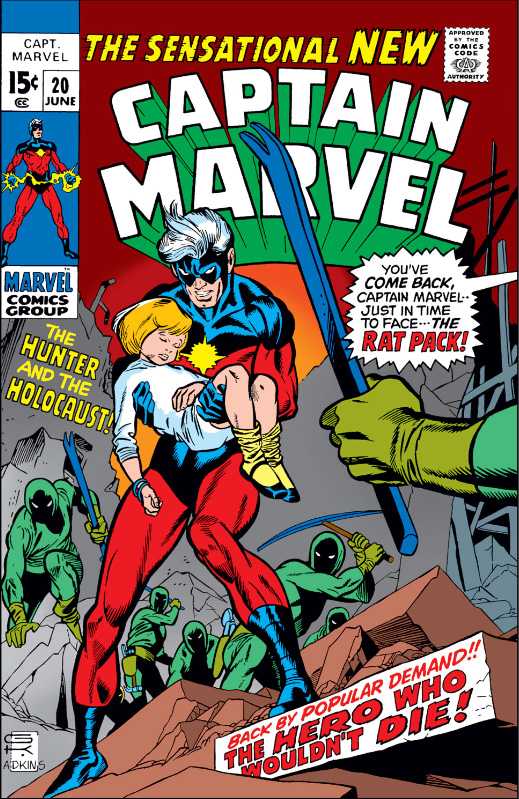
Isabella also takes a deep dive into Marvel history for his villains.Only the film-buff auteurs like Doug Moench and Don McGregor seemed to be averse to plundering the Silver Age. Isabella resurrects The Rat Pack: uniformed looters from my second and final Kane/Thomas Captain Marvel from 1970. I got this in East Kilbride, around the age of 7. Rats make perfect prey for the warrior of the Cat People, natch.
Tigra travels from Chicago to Southern California, where the identity of one of the Cat People, a Prof. Leon (natch), has been revealed as a consequence of a Rat Pack raid. Tigra confronts their leader, the superhuman Joshua Plague and a subsequent attack on a Native American reservation results in the involvement of Red`Wolf, whose own short-lived series had folded in the autumn of 1973.
Isabella utilises first person narration and his Tigra is a confident, proactive, even aggressive heroine. He establishes a mysterious nemesis for Tigra, a supporting cast and re-establishes the South-west locale. Meuginot's civilian fashions for Tigra remind me of Carly Simon's No Secrets look.
My first issue of Marvel Chillers is the next one- number 4, cover-dated April 1976. US Marvels had been coming back to South Lanarkshire during my first year in secondary school, after the dearth of 1973-1974 although some, like Avengers and Tomb of Dracula were slower to do so, while there were still UK weeklies with similar titles. I was buying one a day and trying everything new.
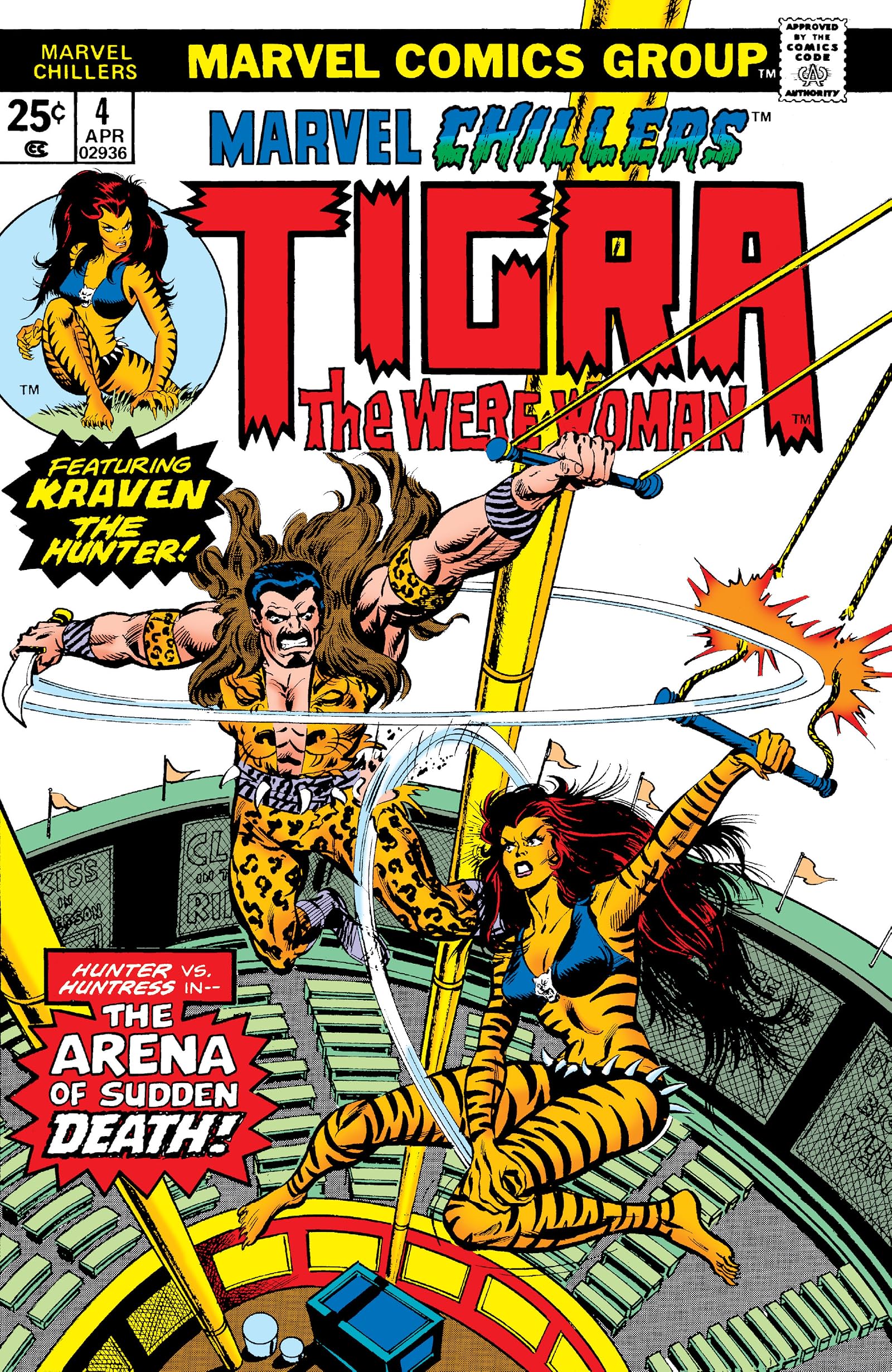
Marvel Chillers 4 is a fill-in, however, but a superior one in my book. The art is by Frank Robbins, whose rubbery figures and period detail I found arresting on Invaders. I love Robbins but I know he's an acquired taste. The script is by Chris Claremont again. He makes passing reference to the Rat Pack but the story is actually about Tigra rescuing a surgeon kidnapped by Kraven the Hunter, to restore a crippled child's mobility. Like Man-Wolf before her, The Most Dangerous Game motif makes sense for Tigra ( and other, later Kraven prey like the Beast or Captain America). Her mission is a noble one and Claremont plays up her hyper-sensitive hearing, her empathic nature and her animalistic side. He even nods to the 70s economy with the recession-struck circus setting. The story is pacy and the heroine sympathetic and feisty enough for me to come back next issue- but I'm saving that for next time.
All images are presumed copyright of their original owners

No comments:
Post a Comment